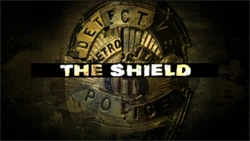
Shield Slam
One unit, one slam, zero witnesses who get to walk away unbruised.

The Shield Slam is a signature coordinated takedown associated with the C.R. Unit, the corrupt LAPD squad at the heart of Fox's crime drama The Shield. Rather than a single character's trick, it functions as a group expression of the unit's philosophy: when words and procedure fail, the squad moves as one body to end a confrontation through overwhelming physical force.
In the show's visual grammar, the Shield Slam is the moment the camera lingers on the geometry of violence—how one officer drives the suspect's weight into the ground while another controls the head, a third locks the limbs. It is less a martial-arts technique and more a street-level, full-contact resolution that the unit treats as a professional courtesy. Fans recognize it as the physical punctuation mark on the C.R. Unit's brand of 'getting things done.'
- Type
- Coordinated physical takedown / group combat technique
- Affiliation
- C.R. Unit, LAPD (fictional)
- Primary users
- C.R. Unit officers operating in concert
- Setting
- Los Angeles streets, alleys, and interrogation spaces
- Tone
- Gritty, procedural-violence realism
- Series
- The Shield (Fox, 2002–2008)
Lore & Background
The C.R. Unit operated under a code that was its own: the badge was a tool, not a shield. When a suspect, a rival, or a situation demanded a resolution that paperwork could not provide, the squad defaulted to the most direct language they had—bodies moving in concert. The Shield Slam crystallized that ethos into a single, repeatable image. One officer would step in and drive the target's center of gravity downward while a second controlled the upper body, turning a standing confrontation into a controlled collapse. The result was not a fight; it was a correction.
What made the move resonate with viewers was its choreographic honesty. There was no spinning, no theatrical flair. The camera framed it the way a bystander would see it: a sudden, ugly, efficient application of weight and leverage. The unit's internal hierarchy dictated who initiated and who finished, and the choice of who delivered the final slam often carried narrative weight—Shane Vendrell's eagerness, Vic Mackey's cold calculation, or Cedric Daniels' reluctant compliance all read differently through the same physical action.
After the unit fractured across the series' later seasons, the Shield Slam became a ghost. Former partners who once moved as a single organism now had to improvise, and the clean, synchronized geometry of the original technique degraded into something messier, more desperate. Fans noted that the move's absence in later confrontations was almost as telling as its presence: the unit's violence had been its grammar, and once the sentence broke, the words lost their shape.
In Their Own Story
The alley behind the 7th Street precinct smelled of wet cardboard and old rain. Three of them fanned out without a word—the way they always did, shoulders checking angles, feet finding the same rhythm. The suspect had his back to the brick wall, hands up, breathing hard. The one on the left stepped in first, not to strike but to take the weight, driving a forearm under the chin and behind the knees. The second locked the jaw. The third was already behind, palms flat on the shoulder blades, guiding the descent.
The concrete took the sound of it. A thud, short and final, like a door closing in an empty house. The suspect was on his back, wrists already moving toward the zip-ties. The three of them straightened, adjusted their sleeves, and walked back toward the squad car as if they'd been checking a mailbox. Nobody in the alley would remember the exact order of the hands. They'd only remember the weight, the sudden stillness, and the fact that it was over before it really started.
Reader's Guide
The Shield Slam is executed in three beats, almost a single exhale. Beat one: the lead officer—usually the one closest to the target's center line—steps in and drives the suspect's torso downward, collapsing the knees or hooking the legs to remove balance. Beat two: a second officer controls the head and upper spine, preventing the target from twisting, buckling, or reaching for a weapon. Beat three: the third officer delivers the finishing pressure, a controlled palm or forearm drive that seats the suspect flat against the ground or wall.
On camera, the sequence is shot tight and low, often from behind the initiating officer's shoulder so the audience feels the geometry of the bodies rather than watching a spectacle. The sound design favors the thud of impact over any vocalization. There is no slow-motion, no hero angle. The frame holds for a beat after the target is down, letting the stillness land.
Narratively, the move carried the weight of group identity. In the early seasons, its clean execution signaled the unit's cohesion and mutual trust. After the internal fractures and betrayals that split the squad, the same three-beat pattern appeared in shambles—officers hesitating, timing off, one member pulling back at the last moment. The choreography became a barometer of the unit's health. By the final seasons, what remained was a solo, desperate version of the same idea: one body, no backup, the slam delivered by someone who no longer had anyone to cover their back.
Did You Know?
- The Shield's fight choreography was deliberately stripped of martial-arts flair; the production team wanted takedowns to look like what a trained officer would actually do in a confined space, not a kickboxing match.
- The C.R. Unit's coordinated violence was a storytelling device: the show used who initiated, who finished, and who held back to reveal shifting alliances without a single line of dialogue.
- The series ran for six seasons on Fox (2002–2008) and became a touchstone for the 'anti-hero cop' genre, influencing how subsequent shows framed police brutality as both procedure and pathology.
- After the unit's disintegration in later seasons, the same physical moves appeared in isolation or with broken timing, a visual shorthand fans used to gauge how much trust remained between former partners.
More in Moves & Weapons
Elsewhere in the The Shield universe
Spotted an error? Know more?
This is a living reference — every entry is fact-audited, and reader corrections feed straight into our audit queue. Suggest an edit · See this site's audit record